the Bronx and the lower Westchester towns along its northern edge
Mold Remediation and Removal in the Bronx
Get the mold and the material it is living in out of the building, to a plan somebody independent wrote, with the work checked afterwards by that same independent party.

Mold Remediation quote
If you already hold an assessor's plan, tell us the date on it. If you do not, describe what you are looking at and we will start you in the right place rather than the expensive one.
Would you rather talk it through? Call (315) 640-3590, answered 24/7.
$100 off your first job
Credited by us on your first booked job.
- One credit per customer per property, on your first booked job.
- Valid through December 31, 2026.
Mention this offer when you book. Full terms.
What the removal crew actually does, and what it is working to
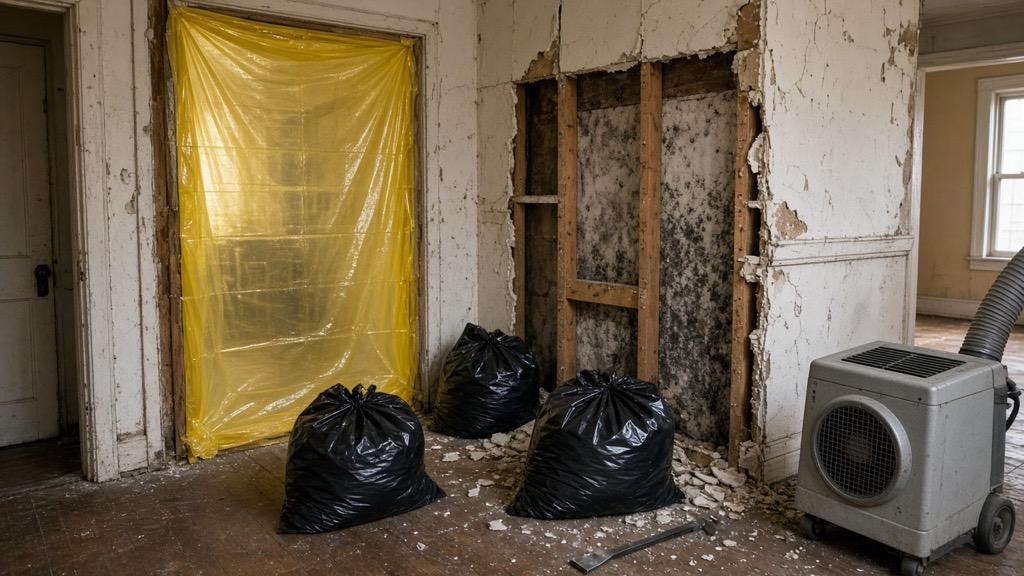
Remediation is the removal half of the job: contain the work area, take out the material that cannot be saved, clean what can be, and leave the space dry and free from visible mold. In New York a licensed remediation contractor works to a plan written by a separate licensed assessor and does not scope or price the job itself. The city's own work practice rule says the same thing in plainer language: correct the underlying defect first, cover or move the furniture, isolate the area with sheeting and seal the ventilation ducts, mist surfaces or use HEPA shrouded tools, bag what is discarded, then HEPA vacuum or wet clean the dust and leave the area dry. Containment stays up until the assessor issues a written passed clearance report.
- Containment with plastic sheeting, negative air and sealed supply and return ducts
- Removal and bagging of porous material that cannot be cleaned, including plaster, drywall, insulation and carpet
- HEPA vacuuming and wet cleaning of surfaces, framing and settled dust
- Detergent and water cleaning of hard surfaces and structure
- Drying the opened area and holding it dry before anything is closed up
- Sequencing around the trade fixing the leak, the pointing or the riser that caused it
- Work to a DEP filed mold remediation work plan where the building is a covered building

What decides the size of a removal job here
The assessor's plan sets the scope, but the building decides how big that plan turns out to be. In the Bronx and lower Westchester these are the factors that move it most.
The measured area, room by room
New York City grades a mold violation by area in one room: under ten square feet is class A with 90 days to correct, ten to twenty nine square feet is class B with 30 days, and thirty or more is class C, immediately hazardous, with 21 days. The measurement sets both the clock and the method.
Whether the moisture driver has been removed
Removal fails when the water survives it. The EPA states there is no practical way to remove every mold spore from an indoor space and that controlling moisture is the way to control growth, and the city rule puts correcting the underlying defect ahead of any cleaning.
What the wet material is
Porous material that has been wet gets removed rather than cleaned. Where a third of the housing stock predates 1940, that usually means lath and plaster keyed into masonry rather than a screwed sheet of drywall, which is slower, dustier and harder to reinstate.
Whether the wall has a cavity at all
Solid masonry has no stud bay to open and no drainage plane behind the finish. Access is cut rather than unscrewed, and putting it back is a plastering job.
Occupied, or empty between tenants
An occupied apartment means notice to the people in it, furniture covered or moved out, and a route in and out that does not carry dust through the rest of the home. Inside the city a vacant unit has to be cleaned and free from mold before a new tenant moves in.
How many apartments are in the building
Ten or more dwelling units inside the city line means the remediator files the work plan with the administering agency no later than two business days before starting, and the agency publishes it online within a day. The job cannot lawfully begin the morning it is booked.
What else is in the wall
Pre-1940 stock brings asbestos and lead paint, and both stop a mold crew until they are handled under their own licensing. Finding them mid job is the most expensive way to find them.
Working from a plan, or starting from a wall
Either is fine. What decides who we introduce you to is whether an independent assessment exists yet.
The order a removal has to run in
Read the assessor's plan before anything else
The plan names the rooms, the method for each area, the quantities, the clearance criteria and the protective equipment. On a project over ten square feet, a remediator working without one is working outside the statute.
Deal with the water first, or schedule around it
The city work practice rule puts correcting the underlying defect at the top of the list, and names defective masonry pointing and water infiltration from plumbing as the usual causes here. Sometimes the roofer or the plumber goes first. That is a sequencing reality, not a stall.
Build the containment
Sheeting, negative pressure, ventilation ducts sealed, furniture covered or removed, and a path in and out that keeps the rest of the home out of it.
Remove, then clean
Wet material misted or cut with HEPA shrouded tools and discarded into sealed heavy weight bags, the surfaces that stay cleaned with soap or detergent and water, then HEPA vacuumed or wet cleaned again.
Dry it, and prove it is dry
Nothing is closed up while the material still reads wet. The EPA directs that moldy surfaces are not painted or caulked over and that paint applied over one is likely to peel, which is exactly how a rushed job announces itself six months later.
Hand back to the assessor
The independent assessment licensee verifies the work area is free from visible mold and issues the written clearance report. Containment comes down after that report, not before it.
Collect the paperwork
Inside the city, correcting a mold violation takes an affidavit from the remediator, an affidavit from the assessor, and proof that both the remediation plan and the assessor's final report reached DEP.
Mold Remediation work we have arranged
What mold remediation looks like


Where remediation starts and stops
When you may not need this at all
- Under about ten square feet, the EPA says most homeowners can handle the cleanup and New York does not treat it as a licensed project.
- A residential owner working on their own property is exempt from state mold licensing, and outside the city line so is a landlord's own staff working on their own building.
- Mold on tile or grout is not an indoor mold hazard under the city rule. A bathroom grout line is usually a cleaning and ventilation problem.
- If the material got wet in the last day or two and nothing is growing yet, drying it is the whole job and remediation is the wrong purchase.
- If you rent, the bill is not yours. In a Bronx building of three or more apartments mold is the owner's statutory duty, and 311 routes the complaint to HPD.
What is out of scope
- Writing the assessment or the remediation plan. One company may not lawfully do both halves on the same property.
- Issuing the clearance report. An independent assessment licensee signs that, which is the entire point of the rule.
- The roof, the pointing, the riser, the drain or the grading that let the water in. Those are separate trades, and the removal is wasted without them.
- Asbestos and lead paint abatement, each licensed separately.
- Cosmetic reinstatement beyond making good, unless it is agreed as its own piece of work.
- Anything about a person's health, a lease dispute, or what an insurance policy covers.
Where we arrange mold remediation
- Mold Remediation in Bronx
- Mold Remediation in Riverdale
- Mold Remediation in Pelham Bay
- Mold Remediation in Throgs Neck
- Mold Remediation in Fordham
- Mold Remediation in Mott Haven
- Mold Remediation in Morris Park
- Mold Remediation in Kingsbridge
- Mold Remediation in Yonkers
- Mold Remediation in Mount Vernon
- Mold Remediation in Pelham
- Mold Remediation in New Rochelle
Questions people ask about the removal itself
Can one company look at it and then remove it?
Not in New York, on anything over ten square feet. Section 936 says no licensee may perform both mold assessment and mold remediation on the same property, and that no person may own an interest in both licensees on that property. An all in one offer is the arrangement the statute was written to stop.
How do I know the crew holds a license?
Ask for the number and check it on the state register before the visit. Section 931 makes it unlawful to perform mold work on a project, or even to advertise as a mold contractor, without a license, so a company that cannot produce a number has a bigger problem than your wall.
Will it just come back?
It comes back if the water does. The EPA's position is that no practical method removes every spore indoors and that moisture control is the control that matters, which is why the plan has to name the moisture source where it can be found and why the city rule makes correcting the defect step one.
Can my own super handle it?
In a Bronx building of ten or more dwelling units, no. Administrative Code 24-154 bars the owner, the managing agent and their employees from mold work over ten square feet and requires an Article 32 licensee instead. In Yonkers, Mount Vernon, New Rochelle and Pelham no equivalent local law applies, the state exemption stands, and the same staff may lawfully do it.
What happens to my furniture and the rest of the apartment?
The city work practices require furniture to be covered or removed and the area isolated with sheeting and sealed ducts before anything is disturbed. What leaves the apartment is the porous material that has been wet. What can be cleaned is cleaned in place.
Send us the plan, or send us a photograph
We will match the job to a licensed remediator and set out what the sequence looks like from here.