Mount Vernon mold and water damage help for owners, tenants and managers
Mount Vernon sits against the Bronx's northern edge, yet its buildings answer to their own city code office. Say what is wrong at your address and we connect you with the companies the job needs.
Which side of the city line
Inside New York City: the Bronx
Past the line: Yonkers, Mount Vernon, Pelham, New Rochelle
The ten-unit bar is a city law, so it stops at the line. Each of these places has its own building department, and the state's two-license rule still applies over ten square feet. Section 933's exemptions still apply here, among them an owner working on their own home, and an owner or managing agent using full-time staff on a building of more than four units, unless they do mold work for the public.
Common questions
Does the Bronx's city housing code apply in Mount Vernon?
No. Mount Vernon is a separate city in Westchester County, and its Department of Buildings enforces the state and local codes there.
Can you help with both a Bronx building and a Mount Vernon one?
Yes. The license rules for mold work are statewide, while the city rules that bind owners and managers differ on each side of the line.
The four jobs in Mount Vernon
Four jobs sit behind this page: a reply to a code notice, drying after water, cleanup to a plan, and a written assessment. Choose the one that fits what you see.
Local notes for Mount Vernon
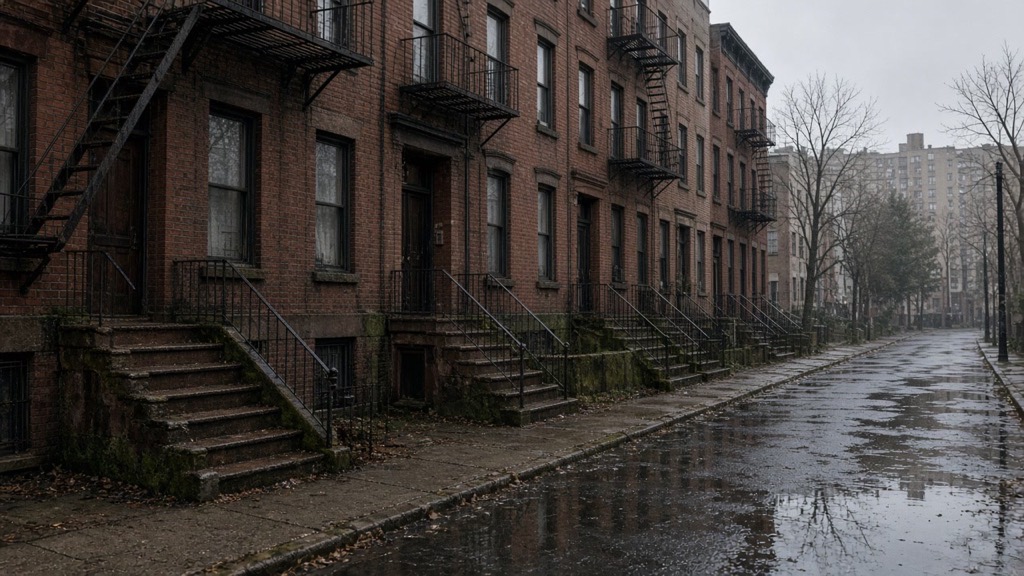
Mount Vernon's housing is old, and more than half of it is rented. Of 30,080 units, 24,796 were built before 1980, the median year is 1953, and 57.1 percent of occupied homes are renter occupied. And 48.4 percent of units are in buildings of five or more apartments. Roofs, risers and masonry of that age give moisture several ways in, and in a multi-apartment building one failure can touch several households.
Water also arrives from outside. Asked whether its flood maps capture the city's risk, Mount Vernon told the county the answer is no, because the remnants of Hurricane Ida flooded places outside the mapped zones. Residents have pointed to sewer overflow along Fulton Avenue and at Columbus and Third Avenues, so an address that looks safe on a map can still take water.
Enforcement sits with the city's Department of Buildings, which applies the state and local codes and housing standards. The Bronx line is also a line in who answers a complaint, so owners and managers working on both sides should not carry assumptions across it.
- Median year built
- 1953
- Old buildings
- 33.8 percent of housing units built in 1939 or earlier
- Renters
- 57.1 percent of occupied units are renter occupied
- Larger buildings
- 48.4 percent of units are in buildings of five or more units
Source: American Community Survey 2020 to 2024 5-year estimates, US Census Bureau
Who handles it here
In Mount Vernon the city's Department of Buildings enforces state and local building codes and housing standards, so a mold complaint about a rental goes to that department rather than to New York City's HPD, and the state Multiple Residence Law and the Property Maintenance Code of New York State set the standard. Source: City of Mount Vernon Department of Buildings, New York State Senate, 2025 Property Maintenance Code of New York State, New York State Department of State
What makes buildings wet
Mount Vernon told the county hazard plan that its flood maps do not capture the real risk because Hurricane Ida flooded places outside the mapped zones, and residents named sewer overflow at several Fulton Avenue intersections, Columbus Avenue and Third Avenue. Source: City of Mount Vernon annex, Westchester County Hazard Mitigation Plan