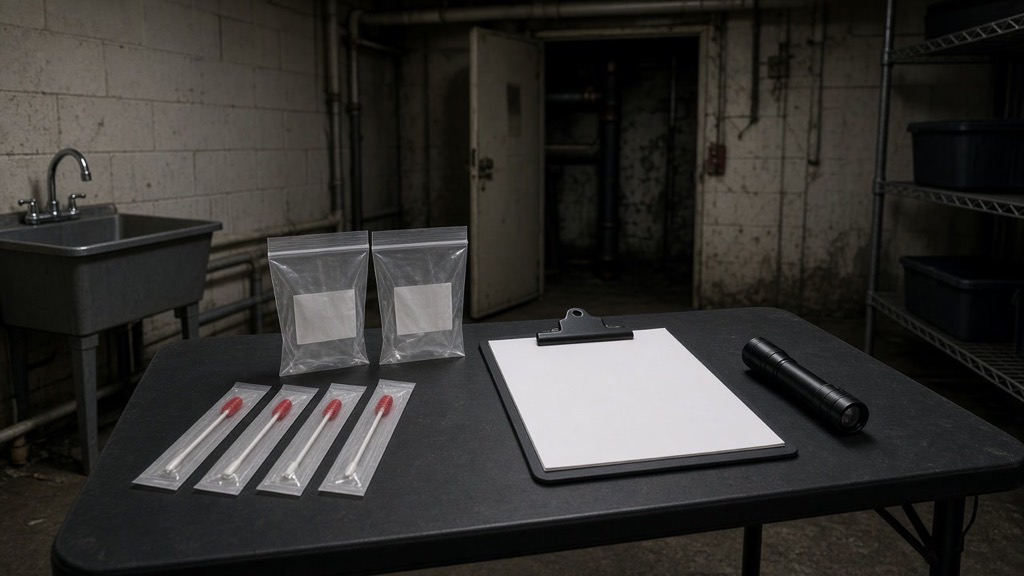
Mold assessment in Mount Vernon, written down before anyone cleans
In a Mount Vernon building that has seen decades of leaks, the assessor's written plan tells you where the water goes and what a cleanup must cover.
Signs this job fits a building in Mount Vernon
Stains that return after a repaint
Older plaster and masonry hide the real source, and paint only changes the color of the problem.
A dispute over who caused it
An independent written finding on the moisture source can settle more than photographs alone.
A block near a reported sewer overflow
If you are close to Fulton Avenue, Columbus Avenue or Third Avenue, ask whether the water came from below.
A smell in a cellar or ground-floor apartment
Odour with nothing visible may point to a wet cavity that only a trace will find.
Common questions
Do I have to find an assessor based in Mount Vernon?
No. The license comes from the state, and the Labor Department's search tool lets you check any assessor before you hire. One assessment company was based in the city on October 6, 2026.
Is an assessment worth it for a small stain?
The EPA's guidance generally leaves a patch under roughly three feet by three to the homeowner. A stain that keeps returning means the moisture is unresolved, and tracing that is what an assessment is for.
Mold Survey in Mount Vernon
Only one mold assessment company and three remediation companies held active state licenses at Mount Vernon addresses on October 6, 2026. An assessor for your job may come from elsewhere, and that is fine: the license is statewide, and the independence is what counts. Ask who you are getting and what the written plan will name.
The building stock explains why assessments here run beyond one wall. With 10,172 of 30,080 units built in 1939 or earlier and 13,811 before 1950, buildings combine original roofs, original masonry and decades of patched plumbing. The assessor prepares the plan; a good one sets out the affected materials and the areas by size, names the moisture source where possible, and says what must be repaired before cleanup counts.
According to the state health department, homes have no state or federal mold standard and no regulator requires testing. A plan built on a measured moisture problem and visible growth gives the Department of Buildings, or a tenant who later asks what was done, something concrete to read.
State law treats mold work on more than ten square feet as a project that needs an assessor holding the state license, and that assessor may not act as the remediator on the same property (Labor Law sections 930 and 936). Source: American Community Survey 2020 to 2024 5-year estimates, US Census Bureau, City of Mount Vernon annex, Westchester County Hazard Mitigation Plan, Mold Contractor Licenses, New York State Open Data, publication 7287, New York State Department of Health, New York State Senate