Kingsbridge mold and water help for the Bronx's big-building blocks
Kingsbridge's apartment houses share walls, risers and a sewer with a buried brook. If one of them has gone damp, we connect you with the right licensed firms, and the opening booking is $100 cheaper.
Which side of the city line
Inside New York City: the Bronx
Housing inspectors score a mold violation by the size of the patch, and every class carries its own deadline. The city also bars an owner, a managing agent and their staff from doing mold work over ten square feet in a building with ten or more apartments, so a state-licensed firm has to.
Past the line: Yonkers, Mount Vernon, Pelham, New Rochelle
Common questions
Is the buried Tibbetts Brook a mold risk for my Kingsbridge building?
The city's environmental protection department describes the brook as flowing into the city sewer, not into buildings, and flood claims in ZIP code 10463 are few. Treat any damp problem as a building question first and ask the assessor what is feeding it.
Does Kingsbridge have more or fewer leaks than the rest of the Bronx?
In the Kingsbridge and Riverdale reporting area 18.6 percent of homes reported leaks in 2017, below the Bronx average of 20.4 percent but above the citywide 13.4 percent.
Who handles mold in a Kingsbridge co-op or rental?
The owner or managing agent has the duty, HPD enforces it for buildings of three or more apartments, and in a building of ten or more apartments licensed firms must do mold assessment and remediation over ten square feet.
The four jobs in Kingsbridge
These four pages cover the jobs that come up in Kingsbridge apartment buildings, from a stain you cannot explain to a notice you have to answer.
Local notes for Kingsbridge
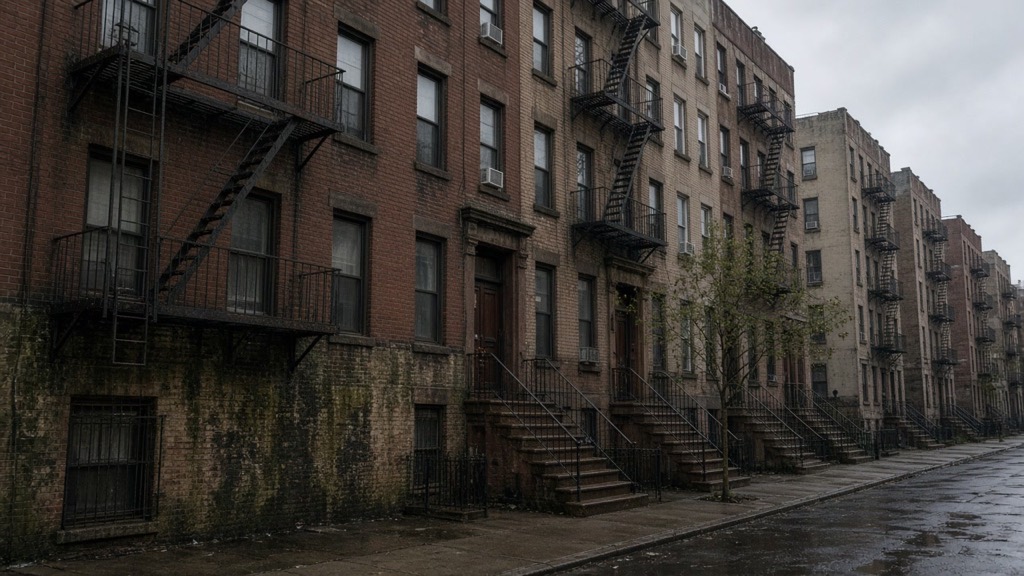
Kingsbridge looks different from the older neighborhoods to its east. In ZIP code 10463 the median building dates from 1955, and only 28.8 percent of units were built in 1939 or earlier. The weight is in the large buildings: 86.8 percent of units are in buildings of ten or more apartments, 64.6 percent of occupied units are rented, and one and two family houses are just 7.4 percent.
For a mold problem that points to a managing agent, a ten-unit-plus building, and the city's covered-building rules. On mold over ten square feet, staff may not do the work, two separate licensed firms must, and HPD enforces the owner's duty to keep apartments clear of mold.
The water story has an unusual footnote. Part of Tibbetts Brook was buried in 1912 and still enters the city sewer at 4 to 5 million gallons a day on dry days. The city is planning to bring it back above ground. Meanwhile flood insurance claims are scarce, just 12 ever in 10463, and FEMA shows minimal hazard at Tibbett Avenue and Broadway, so a damp wall here points first to a leak or a wet cavity in the building.
- Median year built
- 1955
- Old buildings
- 28.8 percent of housing units built in 1939 or earlier (ZIP 10463)
- Renters
- 64.6 percent of occupied units are renter occupied (ZIP 10463)
- Larger buildings
- 86.8 percent of units are in buildings of ten or more apartments (ZIP 10463)
Source: American Community Survey 2020 to 2024 5-year estimates, US Census Bureau
Who handles it here
In Kingsbridge 86.8 percent of units in ZIP code 10463 are in buildings of ten or more apartments, so the owner must keep apartments free of mold, the city's Housing Preservation and Development department enforces it, and work over ten square feet must go to separately licensed assessors and remediators with a city filing. Source: American Community Survey 2020 to 2024 5-year estimates, US Census Bureau, New York City Department of Housing Preservation and Development, Local Law 61 of 2018, The City of New York
What makes buildings wet
Part of Tibbetts Brook was buried in 1912 and still enters the sewer at 4 to 5 million gallons a day on dry days, and although FEMA returns Zone X at Tibbett Avenue and Broadway and only 12 flood insurance claims have been filed in ZIP code 10463, the city's own daylighting project is aimed at relieving that sewer. Source: New York City Department of Environmental Protection, National Flood Hazard Layer, Federal Emergency Management Agency, OpenFEMA NFIP redacted claims, Federal Emergency Management Agency